DSC Flowchart
The LTSI Donor Safety Committee is a multidisciplinary group within the LTSI, headed by the President. Its aim is to improve donor safety standards and to support transplant teams in crisis situations.
Chair: LTSI President
Ex-officio executive members: Past-president, Secretary, Treasurer
Additional members are nominated by the LTSI President for 2-year terms. They must satisfy all of the following criteria:
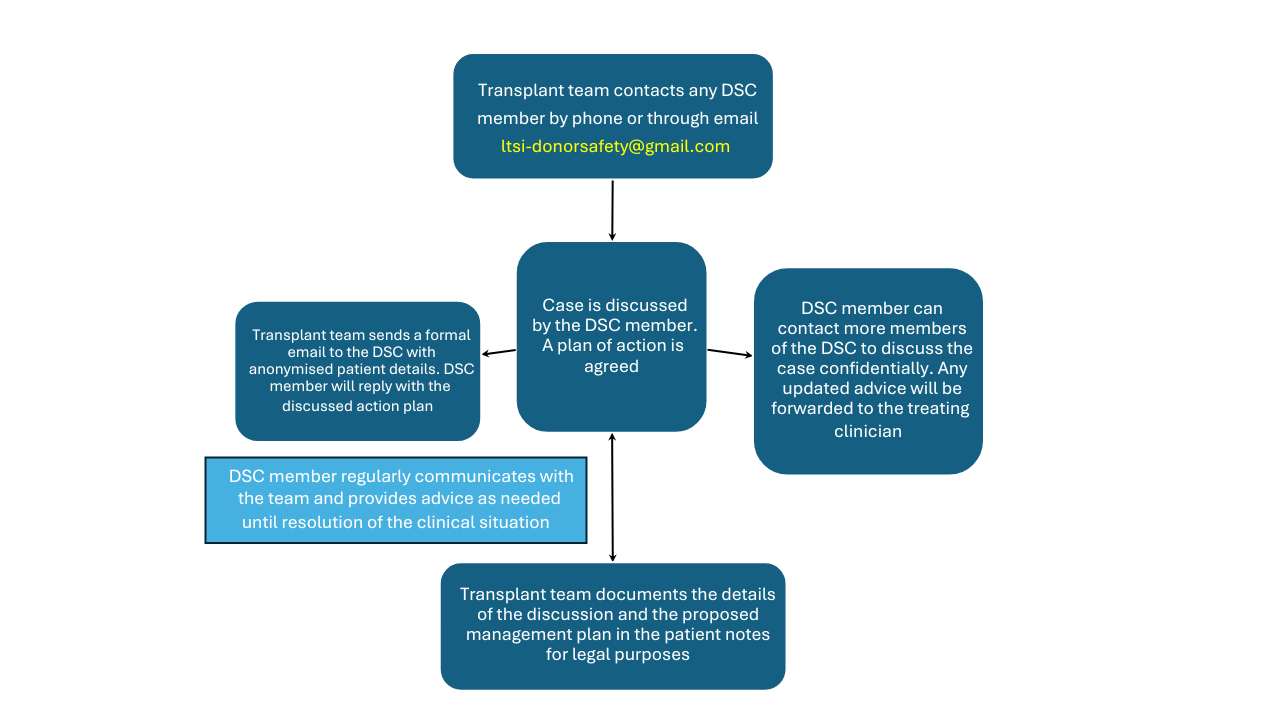
The concerned surgeon or anaesthetist can contact any member of the DSC team for advice and guidance. If the member feels it is necessary, they can discuss the case with other committee members and then provide guidance.
The surgeon or anaesthetist in a transplant team can contact any DSC member for advice about a live donor with an unexpected postoperative course. The member approached first depends on the clinician's choice and the DSC member's availability. It may also depend on the nature of the problem: surgical, anaesthesia or ICU.
If the contacted DSC member feels it is necessary, they can discuss the case with other committee members on a semi-elective basis. In special circumstances, the member or committee can also seek advice from other specialists (radiology, IR, hepatology, ID) before refining the advice. All of this is done confidentially, with patient and center information anonymised as far as possible.
The treating team should document the discussions and the advice given by the DSC in the donor's medical file. This provides legal safety cover for the team and hospital in case of any untoward donor event.
The DSC team should investigate any perioperative mortality after live donor hepatectomy (within 90 days). The aim is to review the perioperative management and identify areas of improvement, if any. The DSC will write to the clinical team, the hospital and SOTTO/ROTTO with a summary of its findings and recommendations.
Information about a donor death may come directly from the donor team. Alternatively, the LTSI President can contact the donor team based on information from SOTTO or other sources.
The DSC meets every 3 months on Zoom, and during the annual and mid-term meetings, to review the work done and identify areas for improvement.
A summary of each case referred to the DSC should be prepared at the end of each donor event where the DSC is involved. The report should cover the nature of the problem, the advice given, the treatment actually provided, the eventual outcome and any learning points. Anonymised reports can be collated and published in JCEH every year as the LTSI Annual Liver Safety Report.